
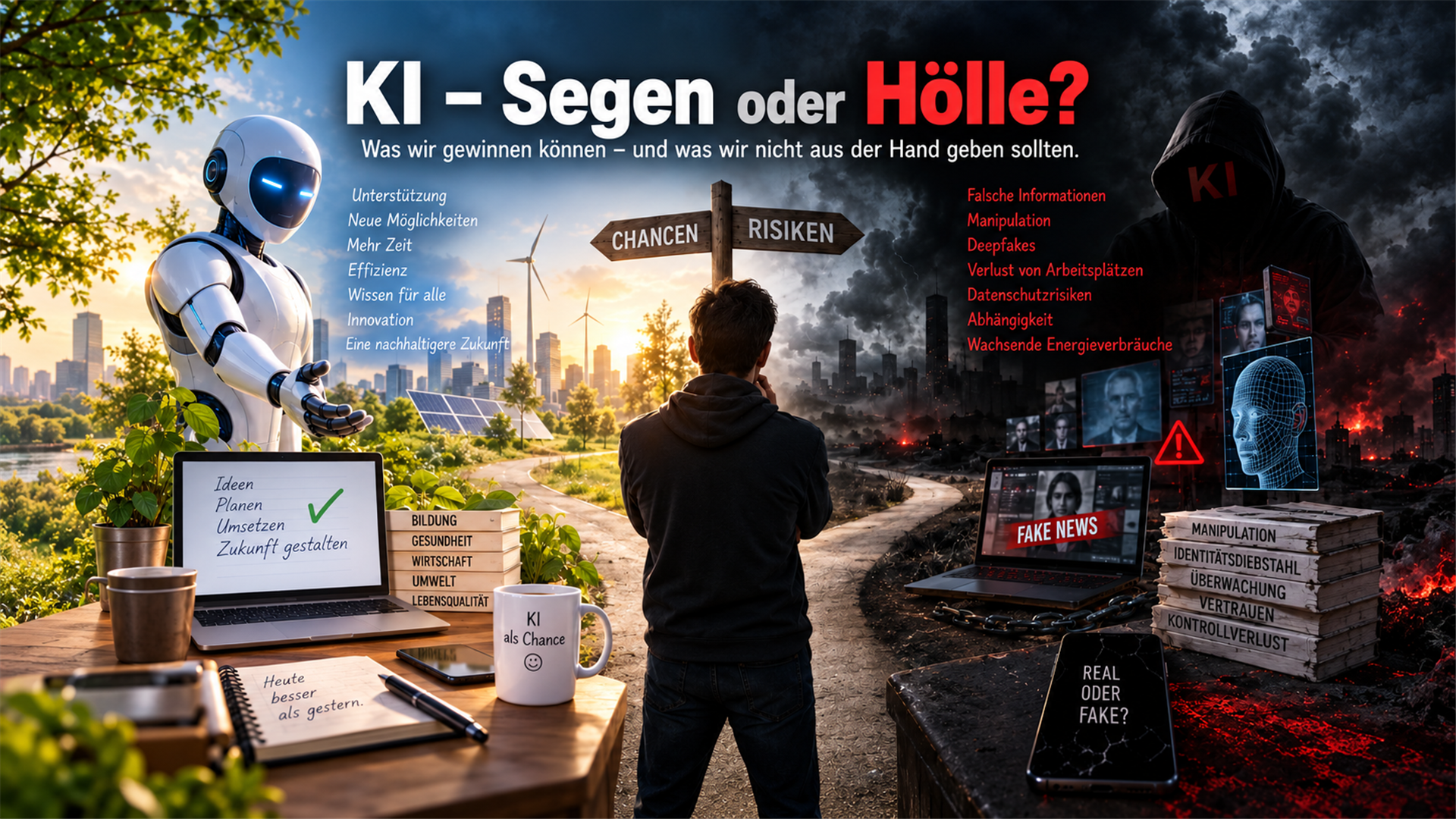
Between promise and risk
Imagine having a digital helper you can ask questions at any time. It never gets impatient, suggests wording and offers ideas. That sounds appealing.
Now imagine that same helper giving you a wrong answer — so convincingly worded that you see no reason to doubt it.
Somewhere between these two possibilities lies my question: is artificial intelligence a blessing — or might we eventually make our own lives hell with it?
That is the question I want to open this blog with. Not a hymn of praise to technology, but not a claim that every new development inevitably leads to disaster either. I am interested in what AI means for everyday life, and where enthusiasm turns into carelessness.
The blessing: support that can make a difference
Generative AI can create content such as text, images, music and videos. This opens up possibilities beyond simply finding information that already exists. [1]
Take a small business: a letter to a customer needs writing, the website needs a clear explanation, and an advertising idea is going nowhere. An AI draft could help someone get started. A person would then check, correct and decide what is actually used.
For me, that is a sensible use of AI. It does not take responsibility away from you, but it can make starting a task easier.
You should not have to be a gifted writer to express your thoughts clearly. Nor should anyone have to justify using a tool. What matters is whether the result is useful.
The benefit would be greater, though, if the time saved also helped people. Less routine, more time for customers, careful work or life outside work: that would be progress to me.
Convincing does not automatically mean correct
The weakness starts when we mistake a well-worded answer for reliable information.
Language models can produce so-called hallucinations: statements that appear coherent but are factually wrong or misleading. Germany’s Federal Office for Information Security, the BSI, also warns about this risk. [2]
That makes things awkward. An obvious mistake is easy to spot. An elegant explanation with a hidden error may not be.
I would therefore make a distinction: in a birthday speech, a phrase can simply sound good. In technical instructions, it needs to be correct. The greater the consequences of a mistake, the more important an independent check becomes.
To me, an AI answer is a starting point, not proof of truth.
I want suggestions and new ways of thinking. But I do not want to hand over the decision about what I believe and pass on to a system.
What happens to our work?
Concerns about jobs cannot be brushed aside by saying that people simply need to adapt.
A 2025 study by the International Labour Organization, the ILO, and the Polish research institute NASK finds that roughly one in four workers worldwide is in an occupation whose tasks are potentially exposed to generative AI. The study sees changes to tasks as more likely than the complete replacement of entire occupations. This figure does not describe job losses that have already occurred or are certain to happen. [3]
For me, the central question remains: how do we shape that change?
Will people get support and training? Or will the same person simply be expected to do much more? Will employees be involved, or only hear about the change after the decision has been made?
I would not measure technological progress solely by how much a company can save. To me, it also means giving people a fair chance to keep pace with change.
When we can no longer simply trust our eyes and ears
Deepfakes are a particularly troubling application. AI can imitate voices and manipulate images or videos, among other things. The BSI explicitly describes the risk of using these techniques for deception and fraud — for example, a phone call using an imitation of a manager’s voice. [4]
Here, the word ‘hell’ takes on a very concrete meaning. Not a science-fiction story about rebellious machines, but possible harm to real people. A fake call or manipulated recording could accuse someone of something that never happened.
My concern goes beyond any one fake: what happens to our shared life if every inconvenient recording can eventually be dismissed as ‘surely AI’ ?
I want neither to believe everything nor to assume everything is fake. I want to know where information comes from and how it has been checked.
Convenience must not become a blank cheque
It is worth taking a close look at your own data, too. The BSI notes that the operator of an AI application may be able to access the data entered into it. [5]
Before personal documents, customer information or confidential correspondence go into an application, some questions should be answered: who gets access? What is stored? What are the inputs used for? And do I need these data for the task at all?
These are not annoying side issues to me. A useful tool should not require me to trust it with everything without thinking.
The same applies to decisions. When a company or public authority uses AI, ‘the system decided’ should not be an adequate explanation. Responsible people must remain accessible, explain decisions and correct mistakes.
The digital world needs real electricity
Energy belongs in this discussion as well. In its projection published in April 2026, the International Energy Agency, the IEA, expects global data centre electricity consumption to rise from around 485 terawatt-hours in 2025 to about 950 terawatt-hours in 2030. These figures cover all data centres, not AI alone. For AI-focused data centres, the IEA expects electricity consumption to triple over that period. This is a forecast, not an outcome already set in stone. [6]
To me, this is not a blanket argument against AI. It is an argument for considering benefits and costs together.
Not every technically possible application is automatically worthwhile. We should also ask: what problem are we actually solving?
My conclusion: use it without handing over your judgement
I want neither to condemn AI outright nor to trust it blindly.
It is a blessing to me where it supports people, makes tasks easier and opens up possibilities. It becomes dangerous where we stop checking mistakes, pass off responsibility or view other people only as a cost.
Responsibility does not rest solely with individual users. Developers, providers, businesses and public institutions must also answer questions about how safely and transparently they design and use this technology.
I want to work with AI without putting myself at its mercy. I want support without giving up my own judgement.
Perhaps the most important question is not just ‘What can AI do?’ but ‘What do we want to leave to it — and what do we explicitly not want to?’
What do you think? Where has AI genuinely helped you, and for which task would you never let it make the final decision?
Sources and further reading
[1] BSI: Artificial intelligence. Principles and possibilities of generative AI. German source.
Read source ↗
[2] BSI: Weaknesses of LLMs. The State of IT Security in Germany 2025; explanations of hallucinations. German source.
Read source ↗
[3] ILO / NASK: Generative AI and Jobs: A Refined Global Index of Occupational Exposure. Working Paper 140, published 20 May 2025.
Read source ↗
[4] BSI: Deepfakes — risks and countermeasures. German source.
Read source ↗
[5] BSI: Creating text and other content with artificial intelligence — generative AI and its risks. Guidance on input data. German source.
Read source ↗
[6] IEA: Key Questions on Energy and AI — Executive summary. Published 16 April 2026.
Read source ↗