
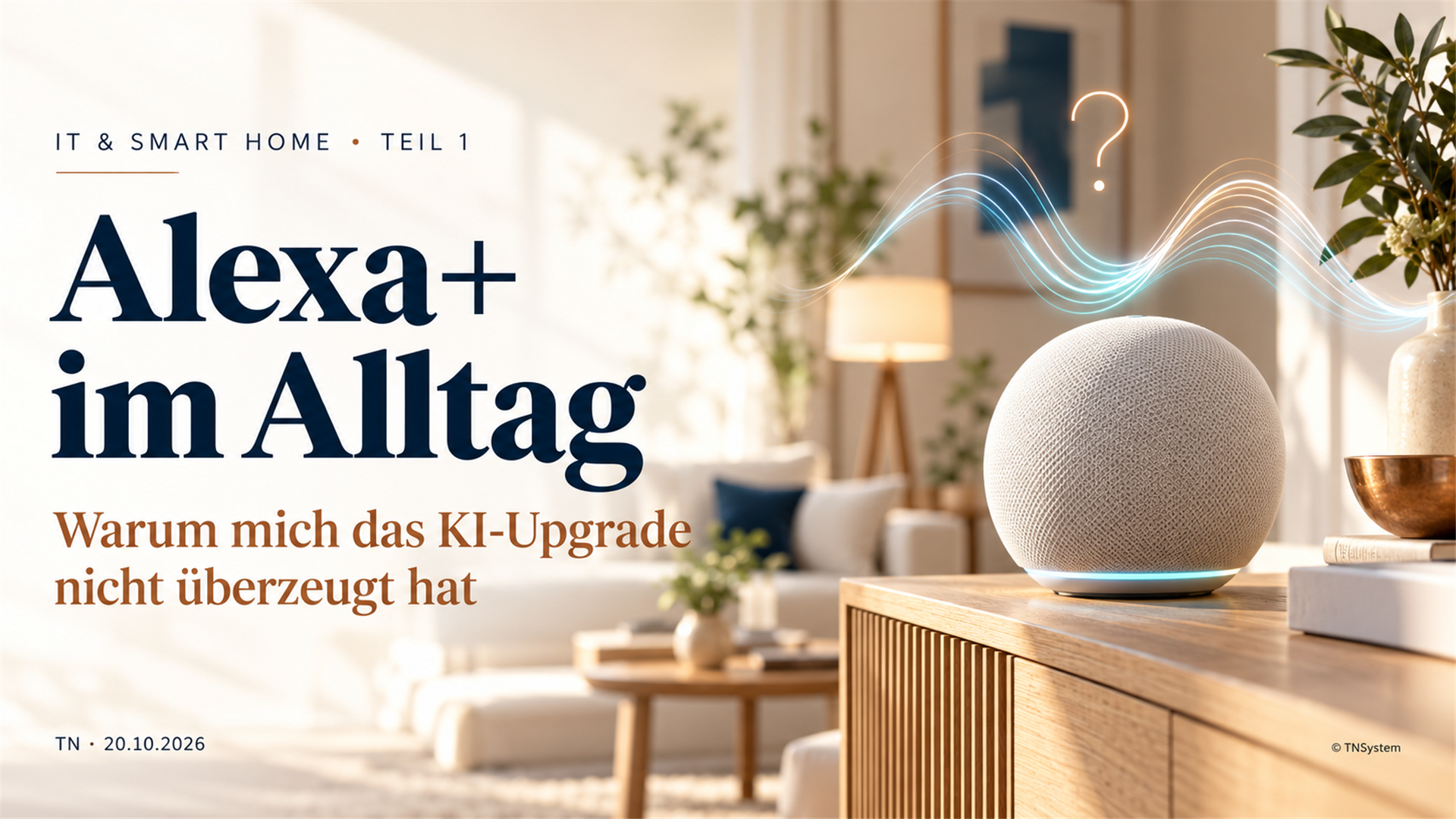
Why I disabled Alexa+ again
A voice assistant is supposed to save me work. When I give a clear instruction, I do not want to have to explain afterwards what I actually meant.
That is where Alexa+ let me down. In my German-speaking setup, requests were understood less well and led to conclusions that did not fit what I wanted. Compared with the previous Alexa, that was not an improvement for me.
So I disabled Alexa+ again.
This is my personal experience, not a laboratory test covering every Echo device and household. It is enough, however, to decide which version I want to use. A new feature needs to help at home, not just look good in a demonstration.
If extra intelligence means that simple tasks need more of my attention, I lose the benefit.
What Amazon promises with Alexa+
Amazon launched Alexa+ in Germany on 7 May 2026 through an Early Access programme. It uses generative AI and is intended to support more natural conversations, retain context and handle multistep tasks. For the smart home, Amazon describes controlling several devices with one request and creating routines by voice. [1]
The idea makes sense. Nobody wants to memorise a complicated sentence for every light. If different ways of asking reliably produce the intended result, that would be a genuine improvement.
The important word is reliably.
I do not need a lengthy conversation about what an instruction might mean. I need the right action, or a short question if something is unclear.
My criticism is not about the new voice
People have different preferences about voices. Some prefer a matter-of-fact tone; others like a more expressive assistant. That is not why I decided against Alexa+.
What bothers me is an answer that misses the meaning of a request. Pleasant wording does not make the result correct, and a convincing explanation does not help if it starts from the wrong assumption.
A simple example explains my expectations: if I ask for a particular light to be switched off, that is the light that should switch off. If the device is ambiguous, I expect a question. Confidently carrying out a different, guessed instruction would not be helpful independence.
This example is not an additional documented incident from my home. It describes how I judge voice control.
Other users describe similar problems
A German-language simon42 community discussion began on 28 August 2026. Several participants described delayed device actions and commands that no longer worked as expected after the change. A post on 29 August described the wrong device being selected and a return to the original Alexa. Other users mentioned trouble finding audio stories. [2]
These are personal accounts, not independently verified fault logs. They nevertheless show that the criticism is not just about a different speaking style. It also concerns everyday functions people rely on.
In a personal WIRED review published on 6 March 2026, Reece Rogers described misunderstood media requests and tasks requiring unusually precise wording or manual intervention on an Echo Show 15. That was a different environment and an earlier stage of development, not specifically the current German version. [3]
There are positive experiences too
Participants in the same German discussion praised being able to combine actions in a sentence and create routines more easily. One explicitly reported no additional delay. [2]
Jennifer Pattison Tuohy's long-term review for The Verge, published on 8 October 2026, also distinguished between tasks: she found substantial improvements in smart-home control but criticised unreliable recall of context and incomplete tasks as a broader personal assistant. [4]
Alexa+ is not equally bad for everyone, nor equally good. A comparison needs to account for language, devices, connected services and the tasks actually used.
Are complaints really increasing?
Public complaints exist. The reports considered here do not provide a reliable statistic showing how quickly their number is growing or how many people disable Alexa+.
Forums mainly reflect the experiences of people who choose to post. They cannot establish an overall error rate. Reports may also concern different devices, countries and software versions.
I would therefore not claim that most users have abandoned Alexa+. What we have are specific critical experiences, positive counterexamples and my own decision to switch back.
That does not weaken the criticism. A reasonable complaint does not need an invented majority.
“Alexa does not understand me” can mean different things
An investigation needs to separate what was heard, how it was interpreted and whether the requested action was then carried out.
Amazon describes Alexa+ as a combination of large language models and specialised systems, interfaces and instructions, rather than a single model directly controlling every device. A failure can therefore arise at different stages. Its architecture description was first published on 26 February 2025 and checked again for this article. [5]
I would distinguish the following questions when narrowing down a problem.
This table is an investigation aid, not a diagnosis of my particular problems.
Amazon lets users review available voice and text history in the Alexa app. This can help distinguish a misheard phrase from a later problem, but it does not explain every internal decision. [6]
An incorrect response does not identify the internal model involved or establish that a particular update was the sole cause.
| Observation | A useful next question |
|---|---|
| A device or room name appears to have been misheard. | What appears in the available voice history? |
| The words are right, but the answer does not fit the request. | Was the meaning or intended device assigned incorrectly? |
| The answer fits, but the device does not respond. | Does the device connection work independently of the voice command? |
New possibilities must not displace established tasks
Amazon describes German Early Access as a way to gather feedback and improve Alexa+. That development stage matters when assessing the experience. [1]
Users can still decide that they do not want to keep testing.
For me, a connected home is not a permanent experiment. A frequently used function needs to work without constant correction. More conversational possibilities do not automatically compensate for worse results on my most important tasks.
I would judge an upgrade on two separate questions: what new things can it do, and how reliably does it do the things that already worked?
The second question matters at least as much as the first.
What I would expect from a better Alexa+
My first priority is unambiguous execution of simple instructions. If several devices could be meant, the assistant should ask rather than treat an uncertain choice as settled.
Honest feedback matters just as much. Being told that a device could not be reached is more useful than an apparent success message followed by my having to check whether anything happened.
There should also remain a practical choice between a more conversational assistant and concise, dependable control. Not every household needs the same features.
Those are my requirements. I would judge a later version against my own tasks, not simply another announcement.
Why I am staying with the original Alexa for now
I did not disable Alexa+ because I oppose new technology. I disabled it because the results in my setup did not convince me.
A voice assistant earns its place through the work it saves. If I need to correct its answers and check its conclusions, that balance changes.
The previous Alexa suited my needs better. That does not mean it is faultless or will remain available unchanged indefinitely.
My conclusion is personal but clear: Alexa+ has not been a step forwards in my everyday use so far. I would rather have an assistant that promises less and carries out my instructions reliably.
About this experience
This article combines TN's own experience with manufacturer information and publicly available user accounts. It is not a standardised comparison of all devices or languages, and does not claim a representative increase in complaints. Features can change.
Sources and further reading
Sources checked on 20 October 2026. Manufacturer claims, personal reports and the author's own experience are distinct.
[1] Amazon: Alexa+ launches in Germany (7 May 2026)
Read source ↗
[2] simon42: Alexa+ experiences (discussion from 28 August 2026; personal accounts)
Read source ↗
[3] Reece Rogers, WIRED: Why Is Alexa+ So Bad? (6 March 2026; personal review)
Read source ↗
[4] Jennifer Pattison Tuohy, The Verge: long-term Alexa+ review (8 October 2026)
Read source ↗
[5] Amazon: Introducing Alexa+, the next generation of Alexa (first published 26 February 2025; updated 21 July 2026)
Read source ↗
[6] Amazon Germany Help: review Alexa voice history
Read source ↗
The companion article
Part 2: How I disabled Alexa+, with the official alternatives for Germany.
Read source ↗