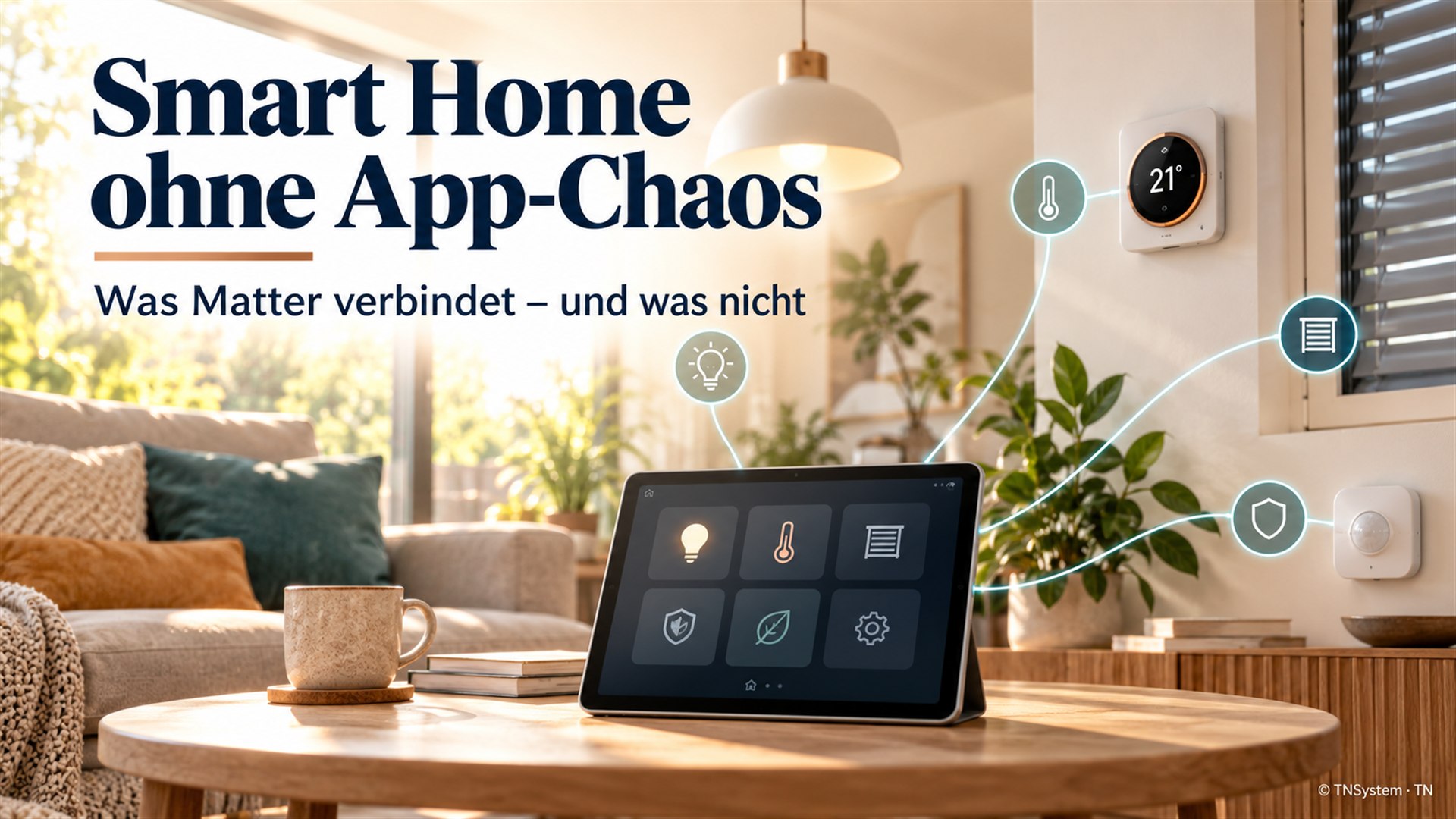
When every light needs another app
One app controls the lamp, another the sensor and a third the socket. Expanding a home should not require creating another isolated system every time.
Matter promises greater interoperability here. I would not equate that with every device suddenly offering every function on every platform.
What is new in the development?
The Connectivity Standards Alliance introduced Matter 1.6 on 17 June 2026, describing improvements to setup and cooperation between ecosystems. [1] On 20 October, the matter.js developer project announced version 0.18.0 with Matter 1.6.1 support. [2]
These are different layers: a standard and a developer implementation. Neither establishes that an existing lamp or controller has already received an update.
Do not confuse Matter with Thread
Matter describes shared application-level communication; the Alliance identifies Wi-Fi and Thread among the underlying network technologies. [3] Thread is not simply another name for Matter.
Before buying, establish which connection a particular device uses and what infrastructure it needs. For Thread, that includes checking for an appropriate Border Router. Assess what is already present before ordering additional equipment.
Shared control has limits
For a device comparison, I would list the required tasks: switching, adjusting brightness, reading measurements or triggering automations. Then check each function on the intended platform.
Special settings, setup procedures and manufacturer updates may still require separate arrangements. I would not delete an app merely because a device carries a Matter label. First establish what the app still does and how operation without it would work.
Local control does not mean independence everywhere
I would test separately what works within the home network, what requires an internet service and what happens if the controller fails. Remote access and voice control are distinct parts of the setup too.
For expansion, dependable and understandable workflows would matter more to me than matching wording on boxes. Keep instructions, setup codes and responsibilities organised. Work on fixed electrical installations belongs with qualified professionals.
My conclusion
Matter is a useful reason to examine smart-home dependencies more carefully, not a reason to replace functioning devices indiscriminately. Start small, test important functions in practice and expand afterwards. The focus here is the system's structure, not another comparison of voice assistants.
Sources and context
Research date: 24 October 2026. Linked vendor and project information is not an independent product test. Examples and recommendations are identified as such.
[1] Connectivity Standards Alliance: Matter 1.6, 17 June 2026
Read source ↗
[2] matter.js: version 0.18.0, 20 October 2026
Read source ↗
[3] Connectivity Standards Alliance: Matter and underlying networks
Read source ↗