
From a useful answer to a connected workflow
An AI drafts a letter, explains a programming error or summarises documents. That is useful. Things become more interesting when it gathers the information it needs, works with applications and turns an assignment into several connected steps.
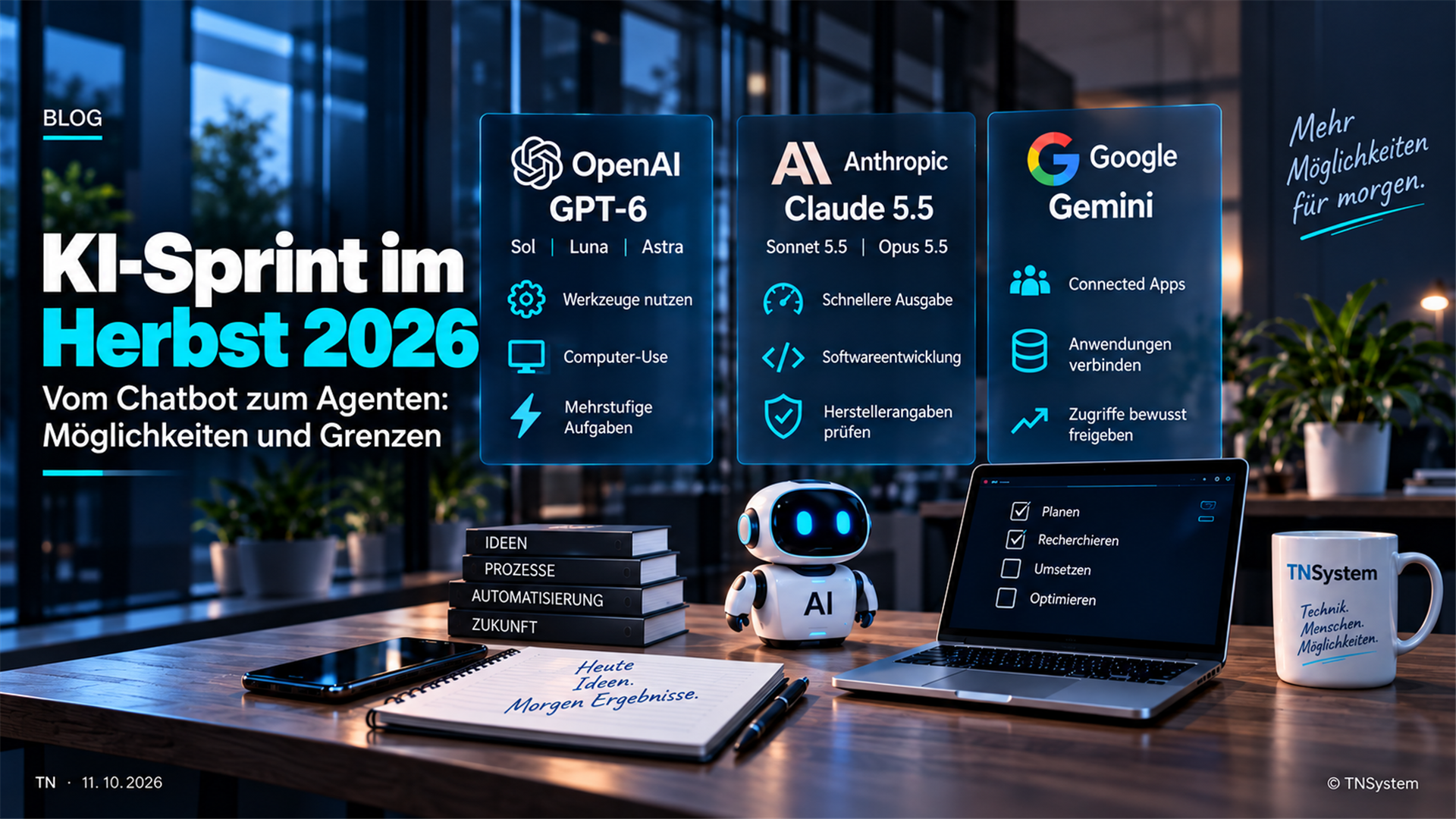
Recent releases from OpenAI, Anthropic and Google are moving in that direction. Alongside better answers, the emphasis is on operating software, handling longer tasks and connecting applications. September and October 2026 announcements illustrate this development. [1][2][4][8]
For me, that is the more interesting part of the competition. Not every new version number changes everyday work. A tool that reliably prepares or completes a clearly defined process can make a real difference.
The test should not be how impressive a demonstration looks, but what subsequently works under our own conditions.
OpenAI: The GPT-6 family arrived in stages
The release dates deserve a closer look. The GPT-6 generation did not arrive all at once at DevDay.
OpenAI released GPT-6 Astra on 3 September 2026, followed by GPT-6 Sol and GPT-6 Luna on 22 September. GPT-6.1 Sol followed on 29 September. These dates appear in the official API changelog. [1]
For Astra, OpenAI highlights computer use, software development and multi-step knowledge work. Intended capabilities include working with applications, analysing information and creating documents. These are the provider's descriptions, not a promise that every assignment will be completed without mistakes. [1]
The published Standard API rates for short-context requests of up to 272,000 input tokens are US$2 per million input tokens and US$10 per million output tokens for GPT-6.1 Sol, compared with US$10 and US$50 for Astra. Long-context requests, cached input, cache writes and different processing tiers have separate rates; tool charges may also apply. These figures are not ChatGPT subscription prices. [12]
Tokens are the units in which the model processes content and usage is billed. They do not correspond to a fixed number of complete words.
For developers, the price difference is interesting. It does not establish which model completes a task most economically. Processing volume, retries and the subsequent review also matter.
Claude 5.5: Faster output and less work
Anthropic released Claude Opus 5.5 on 22 September 2026. It positions the model for demanding programming and knowledge work. In its own tests, the provider reports around 40 per cent lower costs for typical workloads at default settings compared with Opus 5, reflecting both pricing and more efficient processing. [4]
Claude Sonnet 5.5 followed on 28 September. The distinction matters: Anthropic reports output generation more than 30 per cent faster than Sonnet 5. That does not automatically mean every complete assignment takes 30 per cent less time. [5]
According to the release announcement, Sonnet 5.5's regular API rates remain US$2 per million input tokens and US$10 per million output tokens. Because it needs fewer tokens for certain tasks, Anthropic nevertheless reports savings of up to 30 per cent per task in its tests. An unchanged unit price and lower overall costs are therefore not contradictory. [5]
GitHub also confirmed Sonnet 5.5's availability in Copilot on 28 September 2026. Its early tests describe programming tasks completed with fewer steps, tokens and tool calls. That is evidence under particular conditions, not a universal performance guarantee. [11]
I would draw a practical conclusion: comparisons should consider more than the first answer. The work still needed to reach a usable result matters too.
Google: A billion monthly users and new application connections
On 11 August 2026, Google reported that the Gemini app had more than a billion monthly users. This is explicitly an app usage figure reported by the provider. It should not be confused with daily users, paying customers or everyone using other Google AI features. [6]
For practical development, the tasks brought together within an application are also interesting.
On 23 September, Google announced further Connected Apps for Gemini, including project and data management services and design and website-building applications. The intended workflow reduces switching between separate applications. [7]
I see an important competitive question here: however good its answers, an AI leaves part of the work to the user if it cannot reach the required documents and tools.
That is not a reason to connect every account by default. I would set a specific purpose for each connection and allow only the access required for it.
Gemini 4 Argon: An announcement is not general availability
Google introduced Gemini 4 Argon on 30 September 2026. Its announced focus includes complex, longer-running tasks in software development, knowledge work and defensive cybersecurity.
At launch, Google described limited access for selected cyber defenders through its Fairwind programme. Broader availability was to follow further evaluation and feedback. The announcement was not a blanket release to all Gemini users. [8]
For new models, I would always distinguish between an introduction, a restricted trial and actual availability in my own account.
What distinguishes an agent from an ordinary chatbot
A chatbot can explain how to complete a task. An appropriately equipped agent can also call tools, assess results and decide what to do next.
Computer use may involve screenshots, mouse actions and keyboard input. Anthropic's computer-use documentation describes the application executing requested actions and returning the results to the model, which then decides whether further steps are needed. [10]
Preparing a customer quotation could provide an example:
Review the enquiry: Identify requested services and missing information.
Check documents: Consult approved price lists and suitable templates.
Create a draft: Assemble line items and flag outstanding questions.
Prepare the result: Present the draft and its supporting information for review.
This is an illustrative proposed workflow, not a report of a tested TNSystem deployment.
I would draw the decisive boundary before sending it. Preparing a quotation is different from making a binding commitment to a customer. The agent must know where its task ends and approval is required.
Working independently must not mean expanding the assignment without permission.
Competition is shifting towards complete workflows
OpenAI's late-September documentation describes dots: agents intended to keep ongoing work moving with connected tools. Availability depends on the product, plan, region and, where applicable, administrator settings. The current documentation describes a gradual rollout; eligible individual Pro accounts outside the EEA, UK and Switzerland are distinguished from worldwide business workspace rollouts. Availability should therefore be checked for the intended account rather than assumed. [2][9]
Together with Gemini's application connections and Claude's longer-workflow focus, I see a trend: providers are competing not just over the strongest individual answer, but over how much of the route from assignment to result they can handle.
That can be convenient for users. For developers, it changes the task: model requests, files, user permissions and existing applications must all work together.
I would keep interchangeability in mind. A workflow dependent on one provider's special features may be difficult to move later. I prefer a clearly bounded integration to a collection of obscure exceptions.
New plans are not new capabilities
OpenAI's documentation names Pro 100, Pro 200 and Pro 500. These are plan labels, not model generations. Available capacity and processing options must be checked against the current plan; they do not establish whether a particular application can be connected. [9]
I would separate three things: the model, the tools actually available and the amount of usage purchased.
A larger allowance cannot solve the absence of an essential application connection. Nor does faster output guarantee a correct answer to a difficult task.
For a business trial, I would consider the full cost: ongoing usage, setup, supervision and rework. The lowest token price need not produce the cheapest usable result.
Conversely, a clearly bounded routine task does not necessarily need the most expensive available model.
Reading performance claims properly
Release announcements contain many test results. They help explain progress, but their conditions matter.
Results from a research environment or an API are not automatically transferable to an everyday application. Tools, settings and system instructions can affect outcomes. Anthropic also notes that small differences between high benchmark scores may not reliably represent practical differences. [4]
I would not declare a universal winner based on a single bar chart.
For our own business, a comparison using familiar tasks would be more useful: the same documents, the same requirements and a review scheme defined in advance. We could then assess completeness, questions needed and how clearly each solution supports its conclusions.
User counts measure something different from professional reliability. A large audience does not establish superiority on every specialist task.
More ability to act requires tighter boundaries
An incorrect text can be corrected before use. A message already sent, a deleted file or a changed configuration may be much harder to undo.
Anthropic's computer-use documentation warns about additional risks, including prompt injection: a website or document may contain instructions intended to divert an agent from its assignment. Recommendations include isolated environments, minimum permissions, restricted internet access and human confirmation for consequential actions. Such precautions reduce risks; they do not eliminate them. [10]
For an initial business deployment, I would use a test environment with suitable example data. The agent receives only the access needed for the agreed trial.
Actions must also remain traceable. Which file was read? What changed? What evidence supports a claim that the task is complete?
An agent should do more than write a persuasive completion report. Its result must be verifiable against the actual files, changes or tests performed.
When uncertain, I expect a question or a clear stop. A system that quietly invents missing information is not independent in a useful sense; it is unreliable.
How I would begin with the new generation
I would not try to automate an entire business immediately. A clearly bounded process is a better starting point.
Examples include a recurring analysis using approved data, document preparation or a small software change in an isolated development environment.
Before the trial, I would define a correct result. The review would then cover completeness, errors, rework and compliance with boundaries, not just speed and phrasing.
I would also test what happens when documents are missing, a tool is unavailable or two facts conflict. These cases often reveal whether a workflow will hold up in everyday use.
Only after several demonstrably successful runs would I expand the scope. It is less spectacular than a demonstration with extensive permissions, but it makes the actual benefit easier to establish.
My conclusion: Progress lies between assignment and result
Late-summer and autumn 2026 releases bring documented developments: additional GPT-6 models, Claude 5.5, more application connections and approaches to ongoing agent work. The direction is visible. Claiming that every workflow has already been revolutionised would go too far. [1][2][4][5][7]
A new model generation convinces me when it leaves less unnecessary work after a specific task. Verifiable results, respected boundaries and less time spent uncovering hidden errors provide genuine relief.
Ordinary chat is not becoming redundant. A good answer is still enough for many questions. Where several applications and steps are involved, agents may offer more interesting support.
The key question is not how much an AI can do independently, but how reliably it does what we have deliberately entrusted to it.
Scope and research
Research date: 11 October 2026. Performance, cost and usage figures come from provider publications and have not been verified in our own comparison test. Prices and availability may change and differ by account, region, context length or plan. This article provides general technical guidance, not individual legal or purchasing advice.
Sources and further reading
[1] OpenAI: API changelog – GPT-6 releases
Read source ↗
[2] OpenAI: Updates, 28 September to 2 October 2026
Read source ↗
[4] Anthropic: Introducing Claude Opus 5.5
Read source ↗
[5] Anthropic: Introducing Claude Sonnet 5.5
Read source ↗
[6] Google: One billion monthly Gemini app users
Read source ↗
[7] Google: New Connected Apps for Gemini
Read source ↗
[8] Google: Gemini 4 Argon and limited access
Read source ↗
[9] OpenAI: Dots – plans and regional availability
Read source ↗
[10] Anthropic: Computer use and safeguards
Read source ↗
[11] GitHub: Claude Sonnet 5.5 in Copilot
Read source ↗
[12] OpenAI: API prices and processing tiers
Read source ↗