
What this change means
Anyone who has configured a digital assistant for recurring tasks does not want to rebuild it whenever a product changes. Its instructions, reference documents and tested workflows may represent a considerable investment of time.
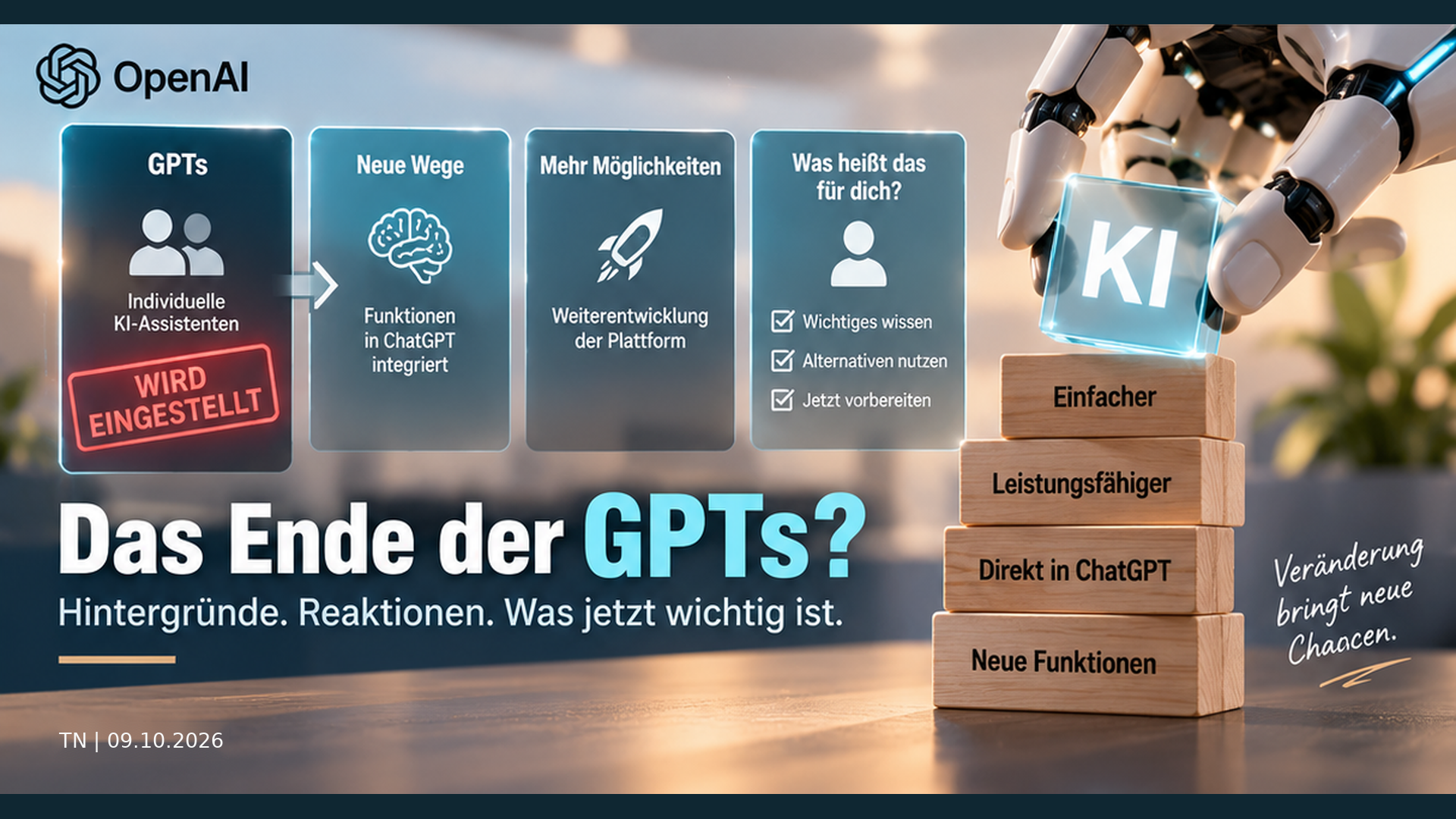
That makes OpenAI's plan to retire Custom GPTs significant. The announcement is official: its ChatGPT release notes of 11 September 2026 describe a planned transition across ChatGPT plans. Plugins are intended to replace these assistants, combining reusable instructions with connected applications. [1]
This is not the end of ChatGPT. It concerns the existing format of individually configured assistants within the platform.
For me, this raises two questions: what will the replacement improve, and will people who already use a specialist GPT still be able to complete their tasks just as reliably?
What “GPTs” means here
Custom GPTs are versions of ChatGPT configured for particular purposes. They can contain their own behavioural instructions, knowledge files and selected capabilities, and may connect to external services. OpenAI describes these components in its product documentation, checked on 9 October 2026. [3]
An assistant might edit text according to established rules, answer questions about reference documents or support a recurring workflow.
The practical idea is straightforward: configure the requirements once rather than explaining them in full at the start of every conversation.
The announced transition concerns these configured assistants, not the retirement of a particular underlying language model.
The dates OpenAI gives
The migration FAQ checked on 9 October 2026 gives these planned dates. [2]
26 October 2026: planned end of new GPT creation in the described Enterprise schedule.
11 December 2026: standard retirement date for Custom GPTs.
11 February 2027: extended date only for qualifying Enterprise workspaces with an approved deferral.
Dates and migration options can depend on the account or workspace. An extension is not automatically available to everyone; the applicable account notice is what matters. [2]
In particular, 26 October is not a general promise that personal-account users can keep creating GPTs until then. The GPT overview, also checked on 9 October 2026, already states that new creation and publication are unavailable for personal Free, Go, Plus and Pro accounts. Existing GPTs remain usable for now, while editing remains subject to the relevant eligibility requirements. [3]
If you use several accounts, check the notices in the account actually affected rather than relying solely on a general announcement.
Why OpenAI is making this change
The official explanation focuses on organising capabilities differently.
OpenAI describes plugins as packages combining instructions, reusable workflows and connections to applications. Their skills can specify how a task should be completed. A plugin can consist entirely of such instructions without connecting to an external service, according to the plugin documentation checked on 9 October 2026. [4]
In its introduction to ChatGPT Work on 9 July 2026, OpenAI had already emphasised connecting ChatGPT with files, applications and multi-step workflows. Plugins are intended to make information and tools available where a task needs them. [4][5]
I see a change in the underlying approach: instead of opening a separate assistant for each purpose, relevant capabilities should be available within a shared working environment.
That could be useful. For work combining research, documents and other applications, avoiding constant switches between separate assistants would be an advantage.
However, the announcements reviewed here do not provide a detailed commercial explanation for retirement. They do not establish that the decision results from low usage, excessive operating costs or a particular profit motive. The official explanation is primarily about the new product structure. [1][4][5]
A plausible technical direction and a well-executed transition are still two different things.
What transfers — and what does not
OpenAI describes instructions becoming skills and knowledge files becoming reference material. Custom Actions do not transfer automatically, nor does the previous model selection. Sharing settings do not carry over, and the replacement plugin starts private. After migration, the original GPT remains usable until retirement but becomes read-only. Existing GPT conversations should remain accessible afterwards. [2]
Migration uses the latest published version: drafts and unpublished edits are not transferred. Creating the plugin does not automatically install it or give other people access. [2]
The lack of automatic migration for Custom Actions is not a minor detail. These interfaces can be essential: retaining a description and documents is not enough for an assistant that depends on a particular external connection.
For a shared assistant, I would not test only my own account. The important question is whether the people it was built for can continue working too.
For me, migration would therefore be complete only when the required tasks actually work. Successfully transferring individual components would merely be an intermediate step.
What users are criticising online
For this article, I reviewed public discussions in the OpenAI Developer Community, on Reddit and a journalist's first-hand account. They illustrate particular views and experiences, not a representative survey of all ChatGPT users or independent verification of every reported fault.
The specialist conversation context might be lost
A Developer Community discussion started on 23 September 2026 raises a fundamental distinction: for these users, a Custom GPT is not simply one workflow but a deliberately selected environment with its own instructions and documents. Their concern is that invoking a plugin inside a general chat may not provide the same consistency throughout a longer conversation. [6]
I find that concern understandable. Someone opening a specialist environment expects its rules to govern the work. A more modular internal architecture is of little help if the user must constantly check which context is being applied.
The official documentation describes both automatic selection of relevant plugins and explicit invocation. Availability depends on factors including the plan, interface and workspace. [4]
This does not prove that plugins are inherently less reliable. It does explain why some users expect more than a technically similar collection of features.
For small providers, customer access matters
Another discussion from 23 September 2026 focuses on freelancers and small businesses. Several contributors say they built specialised GPTs for customers or sold access to them. Their main concern is continued availability: transferring something successfully in their own account does not establish how existing customers will use the replacement. [7]
The business arrangements and support contacts described cannot be independently verified from these posts. The need they express is nevertheless clear: anyone who supplied a tool to others needs a dependable way to continue that service.
I would not dismiss this as mere resistance to change. A new name and interface are one thing; existing working relationships and promised services are another.
Individual users report broken connections
On 4 October 2026, another Developer Community participant reported that an email integration no longer worked after migration. According to the account, instructions and knowledge material transferred, but the required external connection did not. Rebuilding it also presented difficulties. [8]
This is an individual report, not evidence that all comparable integrations fail. It does illustrate why testing a real task matters more than simply confirming that a plugin has been created.
There are positive experiences too
Public reactions are not uniform.
In the discussion started on 23 September 2026, another contributor reports achieving a comparable workflow using a plugin, revised instructions and a project. Some results were reportedly better. The writer explicitly describes this as early testing. [6]
David Ramel also describes a quick, straightforward migration of his own editorial assistant in Visual Studio Magazine on 28 September 2026. He notes that sharing settings did not transfer and that instructions, reference material and output quality still need further examination. [9]
A Reddit discussion checked on 9 October 2026 contains different views as well. Some contributors regard Custom GPTs as an important reason for their subscription, while others suggest projects as an alternative for their needs. [10]
I would conclude neither that the transition has generally failed nor that an improvement is already proven. The previous use case seems decisive: an assistant with a few writing rules has different requirements from an application with specialist data sources, external connections and its own users.
What I would check before switching
I would start with a manageable use case, not the most important assistant. That would reveal which steps are actually required.
First, preserve your own work. For me, that means the instructions you wrote, original files and a short account of what the assistant needs to do. Such documentation would be useful irrespective of this transition.
Next, compare familiar tasks. I would use several typical requests and at least one difficult case. Does the replacement provide the required information, follow the desired format and remain useful after follow-up questions? An impressive opening sentence would not be enough.
Finally, check actual access. A tool for colleagues or customers needs testing from their perspective too. I would switch only once it is clear how authorised users can reach and use it.
Anyone who merely uses someone else's GPT cannot migrate it themselves. OpenAI directs those users to the creator's guidance and replacement offering. [2]
I would also avoid rushing to another provider. Establish which characteristics are indispensable first; otherwise, you may simply exchange one problem for another.
My conclusion: development must be measured against existing work
I support better connections between instructions, documents and tools. A system should be able to evolve without preserving every previous interface indefinitely.
Nevertheless, a replacement promising more capabilities is not enough to convince me on its own.
People who previously worked reliably with a simple assistant should not have to become systems integrators merely to achieve the same purpose. Those who built tools for others need clarity about access, maintenance and availability.
The reactions reviewed here are therefore not just about nostalgia. They concern whether a platform allows people to build something that remains viable after the next major product decision.
I would judge OpenAI by a practical result: can existing users still complete their essential tasks after the transition without having to rebuild a disproportionate amount?
New features are welcome. Reliability is a product feature too.
Dates and user reports
Research checked on 9 October 2026. Announced dates, features and access arrangements may change. The user reports cited are personal experiences, not independently verified findings about every account or application.
Sources and further reading
[1] OpenAI: „ChatGPT release notes“
Read source ↗
[2] OpenAI: „Custom GPT retirement and migration FAQ“
Read source ↗
[3] OpenAI: „GPTs in ChatGPT“
Read source ↗
[4] OpenAI: „Plugins in ChatGPT“
Read source ↗
[5] OpenAI: „ChatGPT is now a partner for your most ambitious work“
Read source ↗
[6] OpenAI Developer Community: „Custom GPT → Plugin is not an equivalent migration“
Read source ↗
[7] OpenAI Developer Community: „OpenAI’s Custom GPT → plugin migration raises access concerns“
Read source ↗
[8] OpenAI Developer Community: „Custom GPT → Plugin migration removed critical Action integration with no supported credential replacement“
Read source ↗
[9] David Ramel, Visual Studio Magazine: „Hands-On With OpenAI’s Mandatory Custom GPT-to-Plugin Migration (Deadline Coming)“
Read source ↗
[10] Reddit, r/ChatGPT: „Custom GPTs are going away by December“
Read source ↗